
If you’ve ever promoted a post on Instagram, you’ve probably seen the “Boost post” button and wondered how different it really is from running a proper advert through Meta Ads Manager. lets take a look at boosted posts v targeted ads.
They both cost money.
They both show your content to more people.
But they do very different jobs.
In this article, we’ll break down the main differences between boosting an Instagram post and running a targeted Meta advert for landing page views (i.e. landing people onto a web page of your choice), and explain which option is best depending on your business goals.
What Does It Mean to Boost an Instagram Post?
Boosting a post is the simplest way to promote content on Instagram. You take a post that’s already live and pay Meta to show it to more people.
How boosting works
When you boost a post, you can:
- Choose a basic audience (location, age, gender, interests)
- Set a budget and duration
- Pick a goal such as profile visits, website clicks, or messages
That’s it. The setup is intentionally limited so anyone can use it.

Advantages of boosting an Instagram post
- Fast and easy to set up
- No technical knowledge required
- Good for increasing reach and engagement
- Helps add social proof (likes, comments, shares)
Limitations of boosted posts
- Very limited targeting options
- No access to custom or lookalike audiences
- Minimal optimisation for website performance
- Limited reporting and insights
- Less control over placements and creative testing
When boosting makes sense
Boosted posts are best used for:
- Brand awareness
- Local visibility
- Promoting announcements or updates
- Increasing engagement on high-performing content
They’re not designed for serious lead generation or sales.
What Is a Targeted Meta Ad for Landing Page Views?
A targeted Meta ad is created inside Meta Ads Manager, not directly on Instagram. This is where professional campaigns are built.
When you choose the Landing Page Views objective, Meta optimises your ad delivery to people who are more likely to:
- Click the ad
- Wait for the page to load
- Actually view your website content
This is very different from optimising for clicks alone.
Key Differences Between Boosted Posts and Landing Page View Ads
1. Targeting capabilities
Boosted posts
- Broad interest targeting only
- No customer data
- No remarketing
- No lookalike audiences
Meta Ads Manager
- Custom audiences
- Lookalike audiences based on real data
- Detailed interest and behaviour targeting
- Audience exclusions to reduce wasted spend
If targeting matters to your business, Ads Manager wins every time.
2. Optimisation and performance
Boosted posts
- Optimised mainly for engagement or taps
- No guarantee users wait for your site to load
- Lower quality traffic
Landing page view ads
- Optimised for users who actually load your website
- Better quality traffic
- Higher intent users
- More consistent performance over time
This is crucial if you care about enquiries, bookings, or conversions.
3. Reporting and analytics
Boosted posts
- Basic metrics only (likes, reach, clicks)
- No real insight into performance quality
Meta Ads Manager
- Cost per landing page view
- Click-through rate (CTR)
- Placement performance
- Demographics and audience breakdowns
- Creative and audience testing data
Better data = better decisions.
4. Control and scalability
Boosted posts
- Very little control
- Hard to improve results over time
- Not scalable for long-term growth
Targeted Meta ads
- Full control over placements (Instagram, Facebook, Stories, Reels)
- Ability to A/B test ads and audiences
- Easy to scale budgets once results are proven
- Designed for ongoing optimisation
Boosted Post vs Meta Ad: Which Is Better for SEO and ROI?
From an SEO and digital marketing perspective, the goal is usually:
- Drive qualified traffic
- Reduce bounce rates
- Increase conversions
- Support long-term growth
Boosted posts rarely achieve this because they prioritise visibility over intent.
A Meta landing page view campaign, on the other hand:
- Sends higher-quality traffic to your website
- Supports conversion tracking
- Works alongside SEO rather than against it
- Delivers clearer ROI
The One-Line Difference That Matters Most
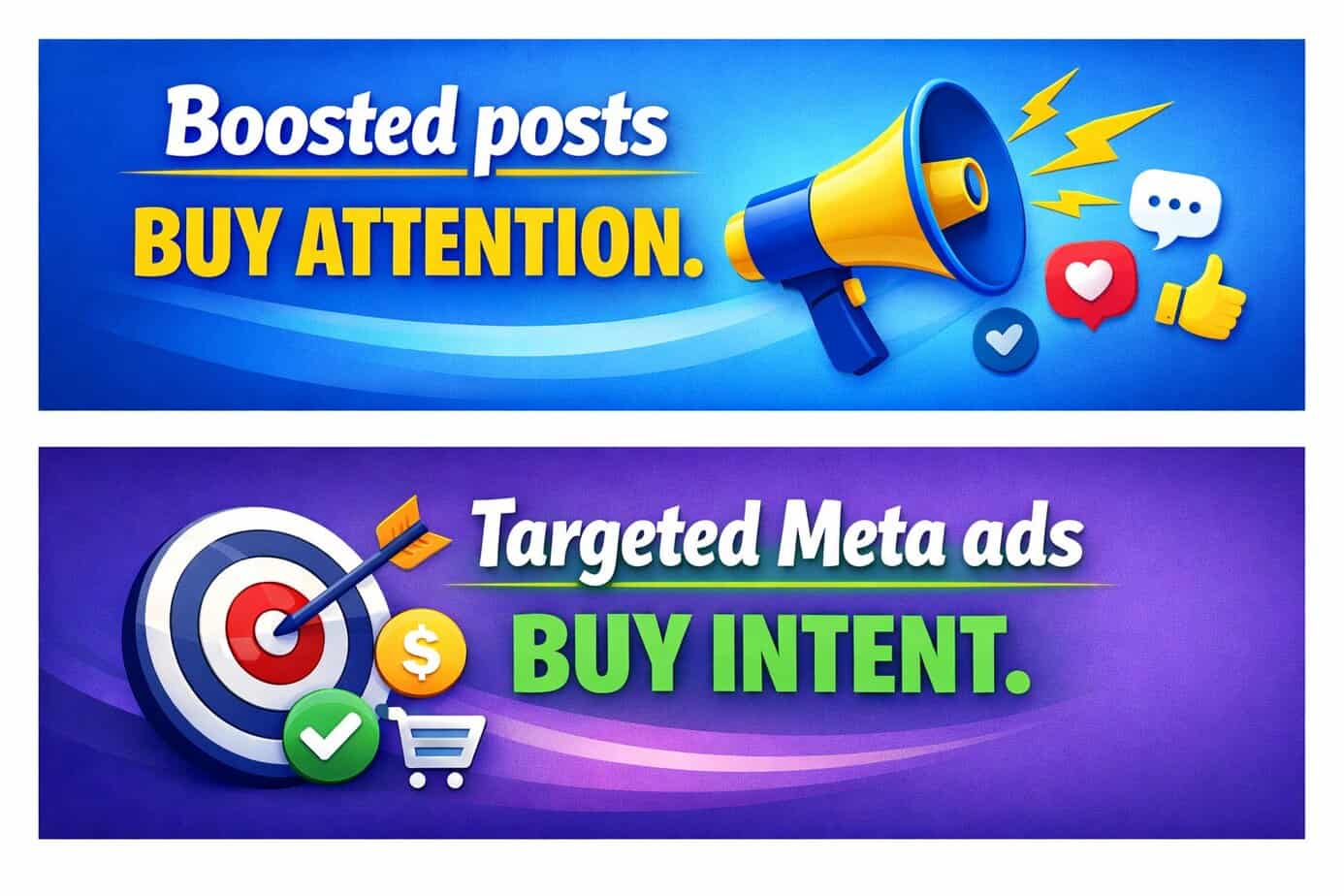
If your goal is anything beyond likes and reach, intent matters.
Thank you for reading. If you need any help with your small business social media advertising get in touch
Thank you to Nancy for inspiring this blog post with your question.